Categories
Uncategorized

Reflecting on the 2025 KSPS Conference: A Weekend of Poetry, Community, and Creative Renewal

Every fall, the Kentucky State Poetry Society gathers writers, readers, teachers, students, and lovers of language together for a weekend that feels less like a conference and more like a homecoming. The 2025 KSPS Conference—held November 1–2 both in person at Joseph-Beth Booksellers and the Lexington Writers Room, and online via Zoom—was a reminder of why poetry continues to matter in Kentucky: it brings us together.

This year’s schedule wove social connection, craft, scholarship, performance, and celebration into two full days of programming that centered one simple truth: poetry thrives where community does.


Day One: Gathering, Sharing, and Celebrating Together

Saturday opened with something beautifully simple—a meet and greet in the Writers Room at Joseph-Beth Booksellers. No pressure, no agenda, just poets reconnecting, meeting new members, and settling into a creative atmosphere. It set the tone for a day that would be equally welcoming and energizing.

The KSPS Welcome Session followed, along with the launch of the fall issue of Pegasus. For many attendees, this felt like a moment of arrival—an annual reminder of our shared work and the art we produce together.

From late morning into early afternoon, attendees explored the Kentucky Book Festival programming on both levels of Joseph-Beth. This open, wandering space between sessions became a highlight for many. There’s something inspiring about discovering authors, listening to snippets of panels, and browsing bookshelves—all with a community of fellow writers around you.

The afternoon keynote brought everyone together on the Main Stage with a conversation between Silas House and Kathleen Driskell—two voices who have shaped contemporary Kentucky literature. Their dialogue invited reflection on place, memory, responsibility, and the role of writers in challenging times. It was the kind of keynote that lingers.

The day closed at the Lexington Writers Room with a reception, open mic, and mini book fair—a space where emerging and established poets read side by side. It carried that mix of vulnerability and celebration that defines the KSPS community.


Day Two: Craft, Learning, and Creative Momentum

Sunday moved online, but the energy didn’t fade. If anything, the virtual format opened the door for even more participation from poets across Kentucky and beyond.

The day was packed with craft-focused workshops such as:

  • “What the Record Shows” with Lynnell Edwards, where attendees explored archival and documentary materials as poetic source.
  • “Your Dangerous Poem” with Letonia Jones, a generative session that encouraged poets to step into boldness.
  • “Sound & Sense” with Marianne Worthington, who guided participants through sonic properties that give poems their resonance.
  • “Poetrizzle Fo’Shizzle” with Tom C. Hunley, a playful and inventive dive into form and creativity.

Breaks between sessions offered needed breathers and informal conversation, preserving the human pace of an in-person event.

The Members-Only Business Meeting anchored the early afternoon—a reminder that KSPS is a member-powered organization continuing to grow and evolve.

Later came one of the most anticipated parts of the day: a poetry reading featuring Shauna Morgan, Lennie Hay, and Matthew S. Parsons. Their voices brought range—lyrical, grounded, experimental—and created a shared emotional thread that resonated with listeners.

The conference closed with a contest winners’ reading and open mic, where both seasoned poets and first-time readers stepped forward. It was a fitting end: a communal stage, a celebration of talent, and an open space for the future.


A Weekend That Reshaped and Recharged

What makes the KSPS Conference so meaningful each year isn’t just the sessions—it’s the sense of belonging. Over two days, writers had the chance to reconnect with familiar faces, meet new collaborators, share their work, learn something unexpected, and feel creatively renewed.

The 2025 conference reminded us that poetry is living work. It grows through conversation. It deepens through practice. It strengthens through community. And it thrives when we gather—whether in a bookstore, a writers’ room, or a Zoom window.

As we look ahead to another year of poems, workshops, publications, and connection, the feeling that lingers is gratitude: for the writers who shared their time, the presenters who shared their wisdom, and the members who continue to make KSPS a vibrant literary home.
Ready to Join the KSPS Writing Community?

Start your membership today.

Categories
Uncategorized

Preparing for the KSPS Annual Conference

The KSPS 2025 Conference is almost here—November 1–2—and it’s shaping up to be an exciting weekend for poets across Kentucky and beyond. Whether you’re a first-time attendee or a seasoned participant, taking a little time now to prepare can help you make the most of the experience. This year’s conference promises craft talks, panel discussions, poetry readings, workshops, and plenty of opportunities to connect with other poets in meaningful ways.

Tips for making the most of the conference:

  1. Plan your schedule in advance: Review the list of talks, panels, and workshops. Identify sessions that align with your interests or areas where you want to grow. Planning ahead ensures you don’t miss your must-attend events.
  2. Bring your writing: Whether you’re working on a new piece or revising an older poem, bring your notebook or laptop. Participate in workshops, join readings, or share your work with peers for feedback. The conference is an ideal space to test new ideas and get constructive input.
  3. Connect with other attendees: Conferences are as much about community as content. Introduce yourself, exchange ideas, and discuss poetry with others who share your passion. These connections often extend beyond the conference, building long-lasting relationships and support networks.
  4. Take notes and reflect: Between panels and readings, jot down insights, favorite lines, and ideas to incorporate into your own work. Reflection helps solidify what you’ve learned and inspires future projects.

The KSPS Annual Conference isn’t just a weekend of events—it’s a chance to grow as a poet, expand your creative toolkit, and become part of a vibrant literary community. Mark your calendar, make your plans, and stay tuned for updates on speakers, panels, and activities that will make this year’s conference unforgettable.

Register now! If you are a student, please use this link to register and receive a special discount.

Categories
Uncategorized

Seasonal Inspiration: Writing into Autumn

As the air turns crisp and the days grow shorter, autumn offers poets a wealth of inspiration. The season is full of natural transformations—leaves changing color, fields being harvested, animals preparing for winter. For many writers, these shifts in the world mirror the changes within ourselves.

Why Autumn Inspires Poets

Autumn carries a sense of transition. It’s a time between abundance and rest, warmth and cold, light and darkness. Poets are often drawn to these in-between spaces, where beauty and melancholy intertwine. A falling leaf can remind us of endings, but also of cycles that begin again. The season’s quiet moods—misty mornings, longer nights, the scent of woodsmoke—create a setting ripe for reflection.

Imagery of the Season

Think of all the sensory details autumn offers:

  • The crunch of leaves beneath your shoes
  • The golden glow of late afternoon light
  • The taste of apple cider or pumpkin bread
  • The hush of wind moving through bare branches

These small observations can spark a poem. Sometimes the most ordinary details—the way sunlight filters through amber leaves or the feel of a warm sweater against cool skin—can open a door into deeper meaning.

Prompts for Autumn Writing

If you’d like to write into the season, here are a few prompts to get you started:

  • Write a poem from the perspective of a single leaf as it falls.
  • Use the harvest as a metaphor—what have you gathered from this year, and what are you ready to let go of?
  • Describe an autumn memory from your childhood. How does it feel different now?
  • Capture a moment at dusk in autumn, when day and night seem to blur.

Autumn as a Reflection

Beyond the natural beauty, autumn often invites us to pause and reflect. It reminds us of impermanence, but also of preparation—the way the earth rests before spring. As writers, we can use this season to ask ourselves: What am I ready to release? What do I want to carry with me into winter?

Categories
Uncategorized

The Rituals of Writing

Every poet has little rituals that bring them closer to the page. Maybe it’s a steaming cup of coffee before dawn, or the habit of drafting longhand with a favorite pen. Some poets read a poem aloud before writing, while others light a candle, put on music, or take a walk to clear their mind.

These rituals aren’t just quirks—they’re part of the creative process. They remind us to slow down, create space, and signal to our brains: it’s time to write.

Why Rituals Matter

Rituals create a bridge between the everyday world and the imaginative one. They help us shift gears, leaving behind distractions and entering a mindset where words can flow more freely. A ritual can also provide comfort. On days when writing feels intimidating, returning to a familiar routine—pouring that cup of coffee, arranging your desk just so—can make the process feel approachable again.

Examples of Writing Rituals

Writers throughout history have relied on their own unique rituals:

  • Maya Angelou rented a hotel room to write, bringing only a dictionary, Bible, deck of cards, and a bottle of sherry.
  • Virginia Woolf wrote while standing at a desk.
  • Toni Morrison famously described watching the sunrise with a cup of coffee before writing, saying the ritual helped her “enter the day and the world with confidence.”

Your rituals don’t need to be elaborate. It might be as simple as setting a timer, opening your notebook, and breathing deeply three times before beginning.

Creating Your Own Ritual

If you don’t already have a writing ritual, experiment with building one this week. Here are a few ideas:

  • Set the mood: Light a candle, play instrumental music, or sit by a window.
  • Use a special object: A notebook, pen, or mug you only use while writing.
  • Mark the time: Write at the same hour each day, even if only for ten minutes.
  • Transition in: Read a favorite poem aloud before starting your own draft.

The Takeaway

Rituals are about creating consistency and connection. They don’t guarantee brilliance, but they do invite presence. Over time, your brain will begin to recognize the signals—this is writing time. And in that space, the words often come more easily.

So this week, ask yourself: what’s your writing ritual? If you don’t have one yet, perhaps it’s time to discover the small, steady practices that will carry you into your next poem.

Categories
Uncategorized

Labor of Love: Why Poets Keep Showing Up

Looking back on Labor Day, we’re thinking about the work behind the work—the effort it takes to write, revise, and return to the page again and again. Poetry, after all, is labor. Not the kind that comes with timecards and breaks, but the kind that demands heart, attention, and resilience.

At Kentucky State Poetry Society, we believe that poetic labor is worth honoring. Whether you’re squeezing in a stanza before bed or wrestling with a manuscript draft, your work matters. It matters to readers, to your community, and to you.

So this week, we invite you to reflect on what brings you back to the page. Is it a sense of wonder? A need for truth? The joy of shaping sound and image?

Here’s to the labor of poetry. The quiet kind. The bold kind. The kind that helps us make sense of the world—and ourselves.

Upcoming Craft Talk with Clay Matthews on September 16

What do marionettes and musical chords, tapestries and trapezes have in common with poetry?

Join poet and professor Clay Matthews for String Theory: An Exploration of Poetry that Employs Multiple Threads—a craft talk dedicated to unraveling the secret scaffolding that holds our poems together.

🗓️ Tuesday, September 16
🕖 7:00 PM (ET)
📍 Live via Zoom (Free with registration)

In this generative workshop, Matthews invites poets to consider how dissonant images, voices, and themes can be braided into a single cohesive piece. What makes some poems feel seamless, even when they’re full of contrast and contradiction? How do you give the illusion of flow when the content is anything but linear?

We’ll read examples of multi-threaded poems, explore the craft choices that allow those poems to sing, and dive into prompts designed to help participants experiment with their own layered drafts. Expect lively discussion, a little risk, and a lot of surprise.

This session is part of our Kentucky Voices programming and is open to all experience levels. Whether you’re working on a sprawling epic or a tight lyric, this talk will offer strategies to balance complexity with clarity.

Registration is open now – don’t miss out!

Ready to start your membership with Kentucky State Poetry Society? Become a member today!

Categories
Uncategorized

The Art of the Second Look: On Revision, Rest, and Returning to the Page

LexPoMo has wrapped, and if you took part in the 30-day writing marathon, you might be feeling a mix of pride, relief—and maybe a little uncertainty. Now what?

At Kentucky State Poetry Society, we believe that the end of writing is never the end of the poem. It’s an invitation. A doorway. A second look.

Whether you wrote 3 poems or 30 last month, July is the perfect time to step back and start revising. Revision isn’t about fixing something broken—it’s about listening closer, discovering layers you didn’t know were there, and shaping your words to say what they truly want to say.

A Few Questions to Begin:

  • Where does the poem surprise even you?
  • Which lines still feel electric weeks later?
  • Which ones feel heavy—or hollow?
  • What would happen if you changed the point of view? The tense? The line breaks?

Sometimes the poem you thought was finished is only just beginning.

Need a Reason to Revisit Your Work?

We’ve got two:

  • Our Poetry Reading is July 15—a great chance to hear how another poet crafts meaning, tension, and emotion in their work—and maybe get ideas for your own revisions in the process.
  • Our Adult Poetry Contest closes July 31. The poems that often rise to the top? The ones that have been thoughtfully revised, trimmed, expanded, and shaped with care.

Tip for the Week: Read Aloud

One of the simplest and most powerful revision tools? Your own voice.
Reading a poem aloud will catch clunky phrasing, weak images, and rhythm that doesn’t quite sing. It can also help you fall back in love with your own language.

So go ahead—step outside, find some shade, and give your poem a voice. You might just hear something new.

We’d love to see where your revision journey leads. Tag us @kystatepoetry —we might feature them in a future post. However you return to your work, know this: every poet rewrites. And every revision is an act of belief in your own voice.

Categories
Uncategorized

Poet Laureate Craft Talk Series with Kathleen Driskell

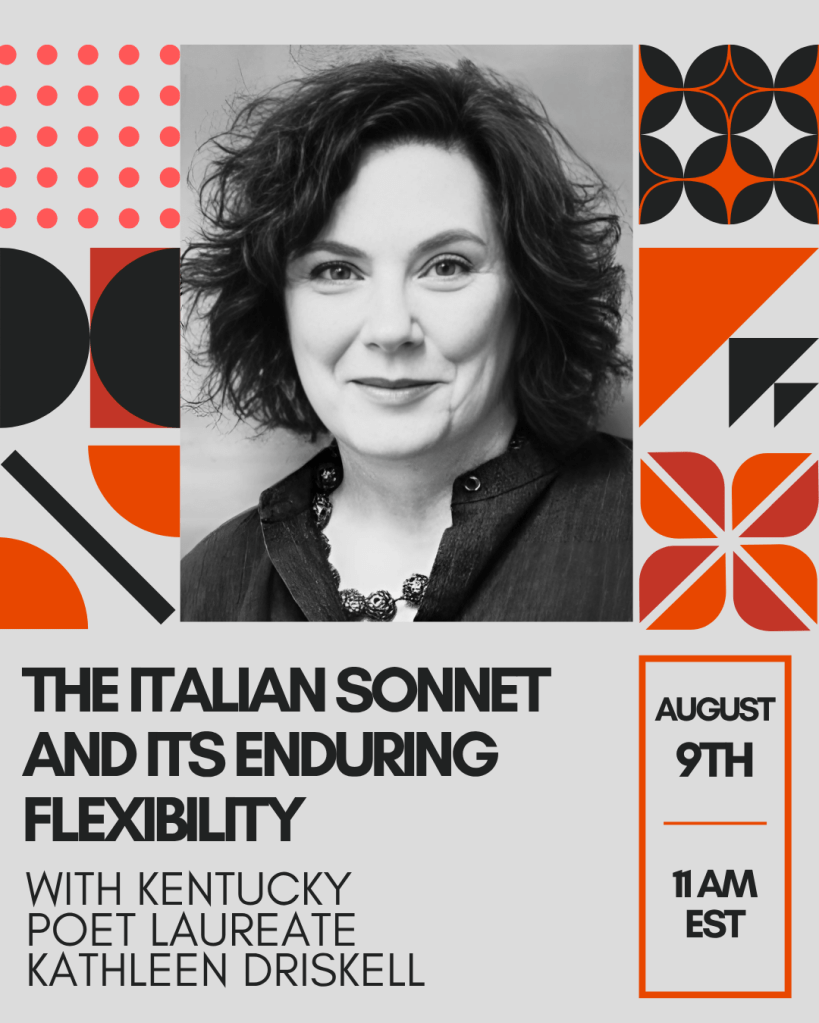
Join us for an exclusive three-part virtual workshop series with Kentucky Poet Laureate Kathleen Driskell, hosted by KSPS. Each session focuses on a different element of poetic craft and includes practical takeaways that poets of all levels can apply to their own writing practice.

Session 1: The Italian Sonnet and Its Enduring Flexibility

Saturday, August 9th | 11am to noon EST

Join Kentucky Poet Laureate Kathleen Driskell as she discusses the fascinating history of the Italian Sonnet and how she relies on the form to write new poems when she’s stuck. Takeaways? Attendees will learn how to use similar strategies to create shapely unified poems of their own, especially helpful when the dreaded writer’s drought surfaces. This session will be capped at 55 registrants.

Session 2: Revision Checklists

Saturday, October 4th | 11am to noon EST

Join Kentucky Poet Laureate Kathleen Driskell as she discusses strategies for revising poems, using a checklist that she’s developed throughout her writing career. Takeaways? Attendees will pick and choose, and come up with their own strategies, creating their own revision checklists that will help them unify their own poems. This session will be capped at 55 registrants.

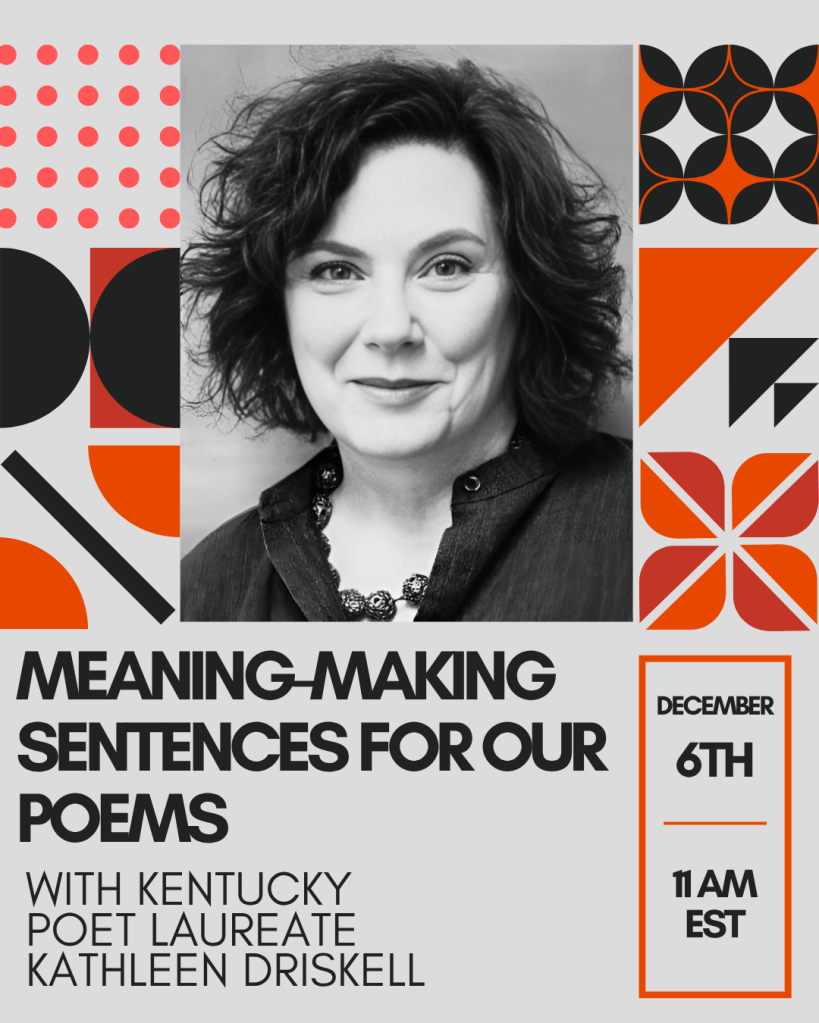
Session 3: Meaning-Making Sentences for Our Poems

Saturday, December 6th | 11am to noon EST

Join Kentucky Poet Laureate Kathleen Driskell as she discusses how her ideas on form and content help her pick, choose, and deploy sentences appropriate in syntax and sound in order to make meaning for our poems. Takeaways? Attendees will revisit and learn new rhetorical and syntactical strategies to put to use in their own poems. This session will be capped at 55 registrants.

While these events are free, we welcome donations via PayPal to support KSPS programming and honor our Kentucky Laureate’s time and talent. Donations of any amount are greatly appreciated. Suggested donation: $25. 

Categories
Uncategorized

Summer Craft Talk Series: Poetry, Process & the Power of the Unspoken

This summer, KSPS invites members to dive into the art and process of poetry like never before. Our Kentucky Voices series is expanding to feature a special three-part virtual craft talk series, each led by a celebrated Kentucky poet and focused on a unique approach to poetic craft. These aren’t your standard readings. These are immersive, reflective, and experimental spaces designed to ignite curiosity and deepen your relationship with the written word.

Our first session kicks off July 15 with “One of These Things Is/Isn’t True: Negation in Poetry” led by award-winning poet and educator Trish Jaggers. This session asks a provocative question: What happens when meaning comes not from what is said—but what isn’t?

“There is no glass in the bathwater.”

With that image, Trish opens a gateway into the poetic potential of absence. In this talk, participants will explore how negation, opposition, and even lies can elevate language beyond its literal frame. Together, we’ll read poems that “tell all the truth but tell it slant,” and examine how emptiness, silence, and contradiction give poems their emotional weight.

This won’t be a traditional workshop. As Trish describes it, it’s “an opening through which we will slip on our way across the water, tiptoeing around the shards that are not there.” You won’t leave with rules—you’ll leave with questions, experiments, and a new lens for your own writing.

📅 July 15, 2025 | 7 PM EST
📍 Virtual | KSPS Members Only
🪑 Space is limited to 55 participants – Register now

Upcoming Craft Talks

String Theory: An Exploration of Poetry that Employs Multiple Threads
Hosted by Clay Matthews | September 16, 2025 – 7 PM EST
What holds a poem together beneath the surface? In this session, we’ll unpack the hidden structures that tether together different voices, moments, and meanings. Through guided prompts, discussion, and practice, you’ll experiment with weaving your own threads—poetic and otherwise—into new creative work.

Craft Your Words: A Multi-Modal Approach to Poetry Writing
Hosted by Lucy Oquaye | November 18, 2025 – 7 PM EST
Poetry can be paper and glue, image and text, absence and form. This hands-on session explores how collage, blackout poems, and zine-making can unlock new poetic possibilities. With tactile tools and a multi-sensory approach, we’ll create poetry that embraces fragmentation and opens new doors of expression

How to Participate

These craft talks are free and exclusive for KSPS members. Each session is limited to 55 participants to ensure an intimate and engaging experience. If you’re not yet a member of the Kentucky State Poetry Society, now’s the perfect time to join. You’ll get access to this series and a full year of member benefits, including publication opportunities, contests, and more.

Start your membership and reserve your spot today.

Categories
Uncategorized

“Commas Are Expensive” by Deidra White

At Kentucky State Poetry Society, we believe poetry can do more than reflect the world — it can interrupt it. It can demand breath in spaces where breath is often denied.

We’re honored to share “Commas Are Expensive” by Kentucky poet Deidra White — a piece that speaks directly to the bone-tired reality of Black womanhood, of single motherhood, of enduring in a world that too often takes without pause.


can someone lend me a comma because commas are expensive you know and periods and question  marks and ellipses for that matter are luxuries for other’s but not me and i know that you know  what i mean for instance when was the last time you were able to question anything while running  around doing fixing solving saving slaying conquering everything that life has thrown your way  like we some sort of super negro slave not tied to the laws of human physicality bending not  breaking losing sleep lifting entire households while we jump over societal obstacles and pits of  financial instability and you better not complain cause then you’re angry bitter broken hurt  damaged as if they didn’t have a hand in building our whipping post and smiled while they checked  for the sturdiness of it and it was so sturdy that it still stands today ready willing and able to soak  up my blood our blood that spills on every street corner and in every country on every towing line  as we pull ourselves through the refuse with entire villages on our backs my god i could use a  comma a question mark an ellipsis but none of those exist in our bag of tricks no rest for this weary  no pause no bell signaling the end of this round of duckingdodgingjabbing no cornerman with  water nor towel to wipe sweat from brow no cut-man to stop the bleeding and i just keep on  swinging and dancing trying to endure the molestation cause that’s what it is you know  something forcing it’s way inside my sanctity and don’t get me started on periods that never end  anything for me i thought at least i can end this run on existence but nah no way no how cause  every period i put down magically disappears like even autocorrect is working against me  making sure that i survive like when i was eleven i attempted a period cause i needed a comma  but wasn’t nopausenobreak nomoment of peace for me to catch my breath so i attempted to put a period there and it didn’t stop nothing and i tried again in my twenties and thirties several times  like i’m done i cannot continue on this tortuous marathon running and leaping over hurdles that i  ain’t see in nobody else’s lane and i be damned if i ain’t still here and i heard you screaming like  Celie i’m poor black and i may even be ugly but i’m here like that’s some sort of accomplishment  and i ain’t saying you wrong for feeling like that cause i know you know the truth about who we  are and what we done and how we came through but they even twisted that into some super negro  strong black woman fallacy like because we make it look so easy it’s ok to keep doing us like  this while they show up ring side with her and say i’m so glad baby that you ain’t that like he  don’t remember that i fought beside him with our kids on my back and i guess i’m just tired and  my attempted periods don’t work and i ain’t never been able to question what’s happening here  cause won’t nobody answer me but you and you got the same questions i do so we just keep  fighting our way through this run on existence hoping that down the line that towing line that  everybody uses for us to pull them through i know you know cause you was right there beside  me fighting for civil rights and women’s rights and voting rights and lgbtqia+ rights and every  other right while we’re being done wrong someone would at least lend me a comma cause fuck  i just wanna take abreakabeatapause just a minute to myself so i can catch my breath a little  seeing that i can’t afford to do that right now because commas are expensive  you know

Categories
Uncategorized

Lines of Liberation: Honoring Juneteenth + the Rhythm of Resistance

On June 19, 1865—more than two years after the Emancipation Proclamation was signed—Union troops arrived in Galveston, Texas with news: slavery had been abolished. For the last enslaved Black Americans, freedom had finally reached their doorstep. That day, now commemorated as Juneteenth, is a celebration of delayed justice, enduring hope, and the unbreakable will of a people.

At KSPS, we recognize that liberation is not a single moment in history—it’s an ongoing act of expression, remembrance, and resistance. And for generations, poetry has been a frontline of that work.

From the spirituals sung in secret fields to the revolutionary sonnets of Claude McKay, from Gwendolyn Brooks’ portraits of South Side Chicago to bell hooks’ fierce meditations on love, justice, and Black womanhood—Black poets have shaped American literature with unmatched power and depth.

Their work is not only literary—it’s liberatory.

Suggested poets to read this Juneteenth:

  • Audre Lorde – poet of truth-telling, queerness, and rage as fuel for transformation
  • bell hooks – Kentucky-born visionary of love as a radical act
  • Lucille Clifton – master of brevity, wonder, and ancestral memory
  • Langston Hughes – the blues poet of Harlem and Black joy
  • June Jordan – bold voice for Black feminism and global justice
  • Nikki Giovanni – a firebrand of civil rights-era poetics
  • Frank X Walker – founder of the Affrilachian Poets, rewriting Appalachia’s story
  • Crystal Wilkinson – lyrical witness to Black rural life in Kentucky
  • Jericho Brown – Pulitzer Prize winner blending music, myth, and survival
  • Terrance Hayes, Tracy K. Smith, Ross Gay, Mahogany L. Browne, Hanif Abdurraqib – and many more shaping poetry right now

We encourage you to spend time with their words this week. Read them aloud. Share them. Let them move you.

 Poetry Tool Spotlight: Meter as a Measure of Freedom

Meter—the rhythm of a poem—might seem like a purely technical tool. But in the hands of Black poets, it becomes a tool of transformation.

Think of how Langston Hughes used jazz and blues rhythms to echo the beat of Black life. Or how Gwendolyn Brooks bent the sonnet form to tell stories the canon had ignored. Meter can be a reclamation—of space, of voice, of breath.

To explore this for yourself, try writing a short poem in a traditional form (like iambic pentameter or the blues stanza), but fill it with your own truth. Or deliberately break the meter—because freedom includes the choice to follow or fracture tradition.

This Juneteenth, we honor not just the history, but the living, breathing art that continues to shape it.

Join us Tuesday, June 17 for our Virtual Open Mic


Whether you’re sharing something rooted in history, a new LexPoMo piece, or just coming to listen—this is a space for community and voice. RSVP link and details here.